NSDSP-3-X
NSDSP Chip NSDSP-1-UX NSDSP-2-X NSDSP-1-3V3 NSDSP-1-5V NSDSP-1-U NSDSP-1-I NSHVX - HVP Extension Adapters Connection Function Programming Debugging USB-to-UART Configuration Speed Tests ICSP Cable Software for NSDSP Interface Library Source Code SDK Supported DevicesNSDSP-3-X
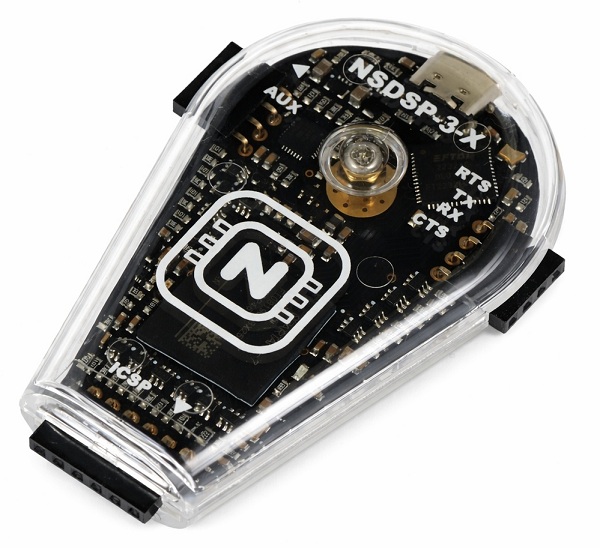
NSDSP-3-X is the newest FPGA based programmer designed for high performance operations.
Features and Benefits
- NSDSP-3-X uses High Speed (480 Mbps) USB connection which allows it to reach USB transfer speed up to 50 MBytes/sec.
- NSDSP-3-X is FPGA based. This allows it to be fast and flexible. The FPGA can be easily re-programmed. Re-programming is fast and takes only 100 to 200 ms. Therefore, NSDSP-3-X is not confined to ICSP, but can support other protocols, such as SWD for ARM32 MCUs. Such protocols can be added without any need in firmware modification and will be added in the near future.
- FPGA also allows very fast communications, up to 100 MHz or faster. That is why NSDSP-3-X can easily support 80 MBaud rates for UART, and 60 MHz for ICSP.
- NSDSP-3-X is likely the fastest PIC programmer and is roughly 3 times faster than NSDSP-1 and NSDSP-2.
- Can program and debug most Microchip PIC® microcontrollers using either HVP or LVP programming.
- A variety of free software programs can be used to configure and control NSDSP. The software can be used for development as well as production programming, including serialized or parallel programming.
- Operating speed is configurable. If the connection between NSDSP and the target PIC device is good, you can use the highest signaling speed. NSDSP-3-X supports ICSP speeds up to 60 MHz, however there's no PIC at this time that would support more than 24 MHz. If you need to use longer cable, or the connection is poor, you can operate NSDSP at lower speeds, as low as 50kHz.
- Each NSDSP device has a unique serial number. This allows multiple devices to be connected to the host computer at the same time.
- At run time, NSDSP can work as UART-to-USB converter for the target PIC (as well as for any other device) with speeds from 4800 baud to 80 Mbaud. In our tests, NSDSP-3-X was able to transfer 3 GB files at 80 MBaud rate without any errors. We also have tested UART data collection at 80 MBaud using dsPIC33AK and it worked flawlessly.
- NSDSP-3-X uses standard Microchip 6-pin ICSP® connector for ICSP programming and debugging. However, the connector is highly configurable and flexible. The same connector will be used in the future for other protocols, such as SWD, and a variety of adapters will be provided. NSDSP-3-X also has generic 4-pin AUX connector adding four more bi-directional pins to adapt to more complex protocols.
- NSDSP-3-X uses USB type C connector and is sold with an USB cable.
- The enclosure is made of transparent polycarbonate and is very sturdy.
- NSDSP-3-X can work at any voltage from 1.7 to 5.5 V.
- NSDSP-3-X has LED Success/Failure indicators
- NSDSP-3-X can power the target PIC device and provide up to 800mA of power at any voltage from 1.8 to 5.3 V. The power may be provided continuosly, or on-demand. To enable target powering, configure NSDSP to provide power and specify voltage.
- When NSDSP-3-X works with a self-powered target, it doesn't draw power from the target as other NSDSP programmers do. Instead, it senses voltage at the VDD pin and uses it to match signaling. This keeps voltage consumption from the target below 50 μA.
- ICSPDAT and ICSPCLK pins are in high impedance state when not in use. Therefore, you can use the target PGC and PGD pins as inputs or drive them with external devices.
- MCLR pin may be put in a variety of states when not programming - NSDSP can set it high, low, put into high impedance state, or pull up with approximately 10kΩ resistor.
Success/Failure Indicator
When an operation succeeds, a green LED is turned on (located on the right side of the programmer).
When an operation fails, a red LED is turned on (located on the left side of the programmer).
The LEDs preserve their states until the beginning of the next operation.
The brightness of the LED lights may be configured.
When both red and green LED lights are on, this indicates error mode. The mode is entered when NSDSP-3-X senses out of spec voltages or currents. In the error mode, NSDSP-3-X tries to disconnect all external circuits, but often the error mode may indicate potentially dangerous conditions where NSDSP-3-X or target may be damaged. Therefore, when an error mode is indicated, it is best to disconnect NSDSP-3-X from all external circuits, then use nsdiag to diagnose the problem.
Voltage Detection
NSDSP-3-X monitors the target PIC voltage. It automatically adjusts the algorithm to the detected voltage.
If the target voltage is not present or is out of the range, NSDSP-3-X refuses to program. To override this behaviour, set the specific voltage in the programming software.
Power on Demand
NSDSP-3-X may be configured to provide power on demand on the VDD pin. In this case, NSDSP-3 does not power the target when it is idle. Instead, it supplies power just before prgramming begins and removes power right after programming whether successful or not.
The voltage for the power-on-demand may be configured permanently or specified every time the programmer is used.
© 2007-2026 Northern Software Inc. All Rights Reserved.